Grid Simulation
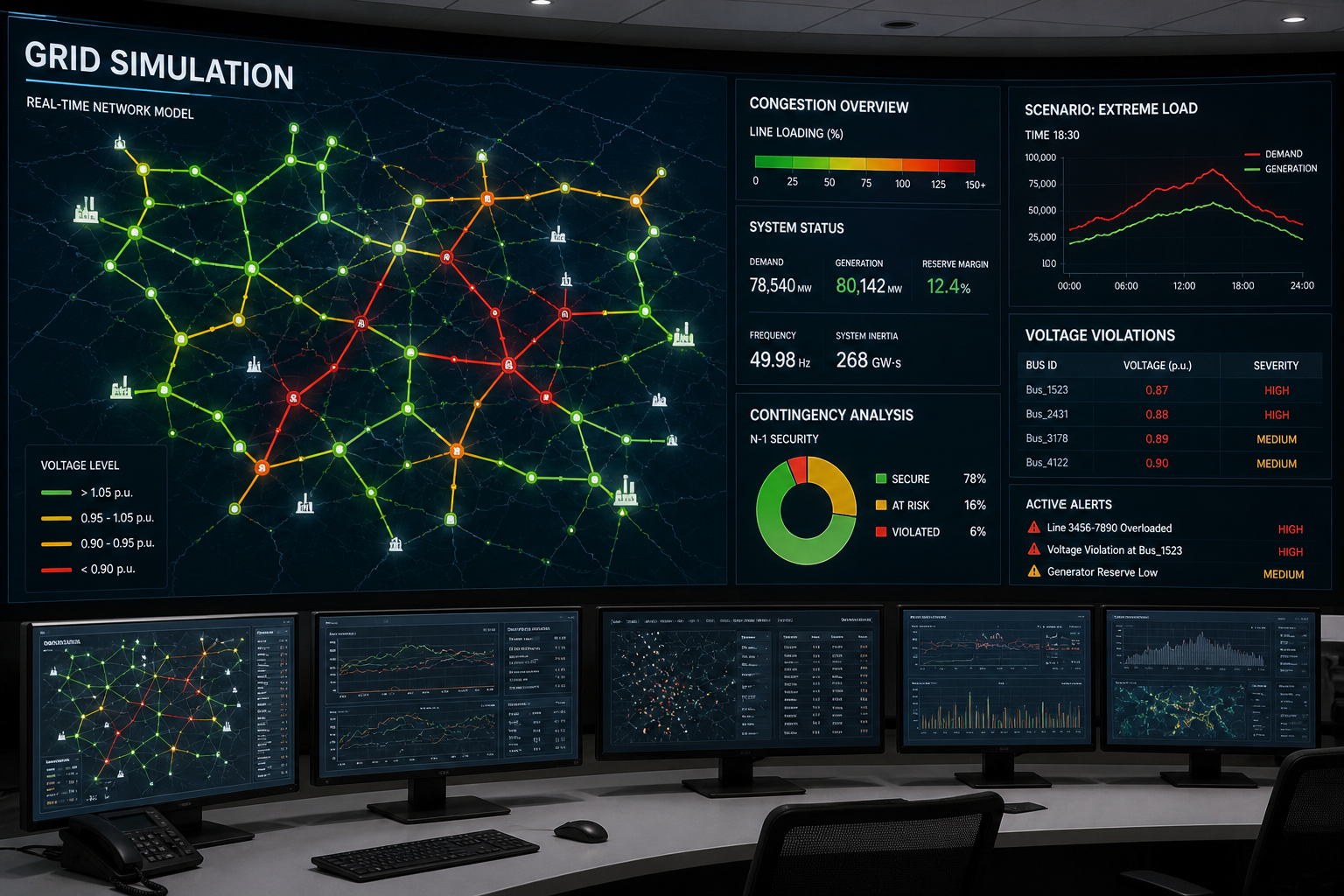
Grid simulation stress-tests power systems under congestion, extreme load, renewable variability and failure scenarios. It helps planners and operators evaluate stability, resilience, bottlenecks and corrective actions before problems occur in the live grid.
What It Is
Grid simulation creates a computational model of transmission and distribution systems to evaluate how electricity flows under different operating conditions. It can test normal operation, high-demand periods, asset failures, renewable ramps and emergency events.
The goal is not only to understand whether a grid works today, but to identify where it may fail under stress and what operational or infrastructure measures can reduce risk.
Key Pain Points
Modern power grids are becoming more complex due to renewable integration, distributed assets, electrification, aging infrastructure and extreme weather exposure.
Simulation Scenarios
Grid simulation is most valuable when it tests plausible stress cases rather than only average operating conditions.
| Scenario | Purpose | Typical Output |
|---|---|---|
| Congestion analysis | Find overloaded lines, transformers and network bottlenecks | Line loading, constraint maps, redispatch needs |
| Extreme load scenario | Evaluate demand peaks caused by weather or electrification | Reserve margin, voltage risk, capacity shortfall |
| N-1 contingency | Test whether the grid remains secure after one asset outage | Violation list, contingency ranking, mitigation actions |
| Renewable ramp event | Assess fast changes in wind or solar generation | Balancing need, frequency risk, storage dispatch requirements |
Simulation Workflow
Grid simulation connects network topology, asset ratings, generation, demand, weather and operational rules into a scenario-based analysis workflow.
Analysis Methods
Grid simulation includes several analytical methods depending on whether the question is about steady-state power flows, dynamic stability or resilience under contingencies.
Role of High Performance Computing
HPC becomes important when grid simulations include large networks, many contingencies, high time resolution, probabilistic scenarios or coupled weather-energy models.
| HPC Capability | Grid Simulation Role |
|---|---|
| Parallel scenario runs | Evaluates thousands of load, outage, renewable and weather scenarios efficiently. |
| Dynamic simulation acceleration | Speeds up transient stability and frequency response studies. |
| Large network scaling | Supports detailed regional or national grid models with many assets. |
| Optimization workflows | Searches for mitigation strategies under constraints such as cost, reliability and emissions. |
Key Performance Metrics
Grid simulation should be judged by both engineering accuracy and decision relevance.
Limitations & Practical Considerations
Grid simulation results depend on model quality, asset data, operating assumptions and scenario design. A simulation can only test the cases that are represented in the model.
Real grids also include human operations, market behavior, protection schemes and communication constraints that may be difficult to represent fully. Simulation should therefore support, not replace, engineering judgment and operational validation.
Related Deep Dives
Grid simulation connects the HPC layer with grid management, weather modeling and energy security.