Weather Modeling
Weather modeling uses high-resolution atmospheric simulations to support wind, solar and grid planning. It helps estimate renewable generation, demand patterns, weather risk and operational constraints across energy systems.
What It Is
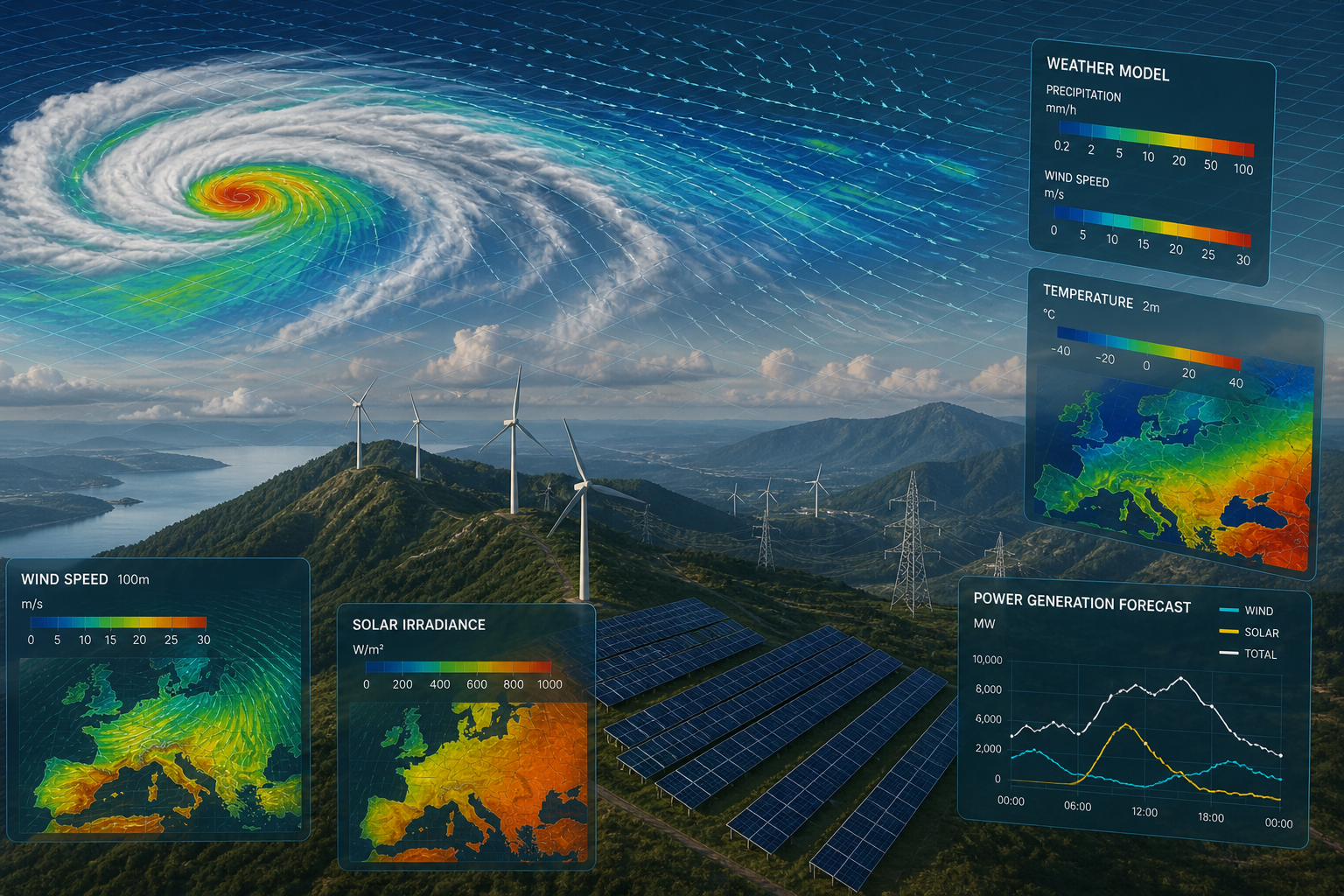
Weather modeling translates atmospheric physics into computational forecasts. In the energy sector, this means estimating wind speed, solar irradiance, temperature, precipitation and extreme weather risks that affect production, demand and grid stability.
High-resolution models are especially valuable when renewable output depends on local terrain, cloud cover, wind shear and fast-changing weather patterns.
Key Pain Points
Energy systems are increasingly weather-dependent. Forecast errors can affect renewable dispatch, reserve planning, market prices and grid reliability.
Energy-Relevant Weather Variables
Different energy systems depend on different weather variables. The value of weather modeling comes from translating atmospheric forecasts into operational energy decisions.
| Variable | Energy Relevance | Typical Impact |
|---|---|---|
| Wind speed and direction | Wind farm output, wake behavior and turbine loads | Generation forecast and turbine control |
| Solar irradiance and cloud cover | Photovoltaic production and ramp events | Solar forecast and storage dispatch |
| Temperature | Electricity demand, equipment ratings and thermal limits | Load forecasting and grid capacity planning |
| Precipitation and storms | Hydropower, asset risk and outage probability | Risk planning and resilience operations |
Weather Modeling Workflow
Weather models combine observations, physics-based equations, data assimilation and numerical solvers. Energy use cases often add post-processing to convert weather forecasts into power and demand forecasts.
Energy Applications
Weather modeling supports both operational decisions and long-term infrastructure planning.
Role of High Performance Computing
Weather models are classic HPC workloads because they solve large-scale atmospheric equations across three-dimensional grids and many forecast time steps. Higher resolution improves local detail but increases computational cost.
| HPC Capability | Weather Modeling Role |
|---|---|
| Parallel compute | Runs large atmospheric models across many grid cells and forecast horizons. |
| GPU acceleration | Can accelerate selected solvers, post-processing and ensemble workflows. |
| Ensemble simulation | Runs multiple forecast scenarios to estimate uncertainty ranges. |
| High-throughput storage | Handles large forecast outputs, historical weather datasets and model archives. |
Key Performance Metrics
Weather modeling should be evaluated not only by forecast accuracy, but also by decision usefulness for energy operations.
Limitations & Practical Considerations
Weather forecasts are inherently uncertain. High resolution does not remove uncertainty; it can sometimes reveal more local variability that must be interpreted carefully.
Energy workflows should use forecast ensembles, confidence bands and operational fallback plans rather than relying on a single deterministic forecast.
Related Deep Dives
Weather modeling connects the HPC layer to renewable operations, storage dispatch and grid planning.