Energy Security
Energy security in modern systems is no longer only about fuel supply or physical infrastructure. It also includes the resilience of digital control systems, distributed assets, grid operations and cyber-physical processes that must remain stable under faults, attacks and extreme conditions.
Energy Security Pain Points
Modern energy systems are increasingly decentralized, digital and automated. This improves efficiency and flexibility, but also expands the attack surface and makes failure propagation harder to predict.
Energy security therefore requires more than perimeter cybersecurity. It needs continuous operational visibility, anomaly detection, simulation-based risk analysis and coordinated response workflows.
Threat Landscape
Energy infrastructure faces a combined risk environment. Equipment failure, cyberattacks, weather events, supply constraints and operational misconfigurations can interact in ways that are difficult to detect with isolated monitoring tools.
The most critical risks are often not single events, but chains of events: a sensor failure, followed by incorrect control behavior, followed by a delayed operator response. Modern security models therefore focus on system behavior, not only known attack signatures.
| Threat Type | Example | Security Relevance |
|---|---|---|
| Cyber intrusion | Unauthorized access to control networks or operational systems | Can manipulate data, commands or visibility |
| Operational anomaly | Unexpected voltage, frequency, load or inverter behavior | May indicate fault, misconfiguration or emerging instability |
| Physical disruption | Equipment damage, extreme weather or substation failure | Can trigger cascading outages or emergency operation |
| Data integrity issue | Missing, delayed or manipulated telemetry | Reduces operator trust and weakens automated response |
Real-Time Anomaly Detection
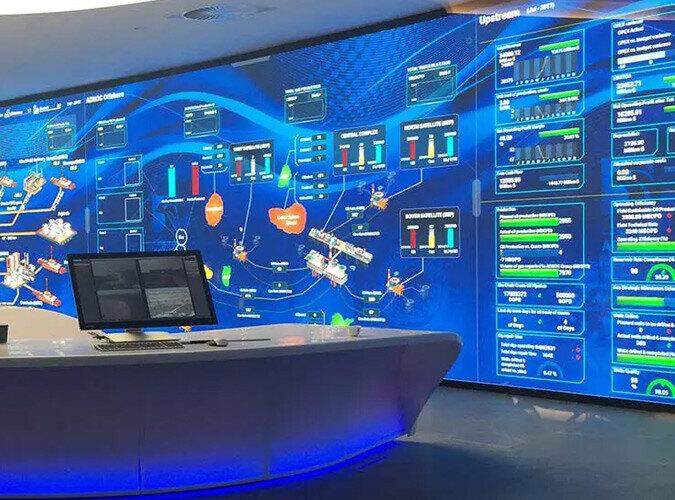
Real-time anomaly detection analyzes telemetry, SCADA signals, sensor streams and operational patterns to identify deviations from expected system behavior. This can reveal equipment faults, cyber-physical attacks, configuration errors or early signs of instability.
Detection models may use statistical baselines, physics-informed thresholds, machine learning or hybrid methods. The key challenge is balancing sensitivity with false positives: too many alerts create noise, while overly conservative models may miss critical events.
Predictive Defense & Shadow Simulation
Predictive defense uses simulation, forecasting and scenario testing to identify vulnerabilities before they become operational incidents. Shadow simulations run digital replicas of the energy system in parallel to live operation, allowing teams to test potential disturbances without interfering with real assets.
This approach shifts energy security from reactive incident response toward proactive risk management. Instead of waiting for failures, operators can evaluate how the system might behave under abnormal conditions and prepare response strategies in advance.

Grid Resilience Deep Dive
Grid resilience describes the ability of the electricity system to absorb disturbances, maintain critical operation and recover quickly. It is broader than cybersecurity alone. A resilient grid can degrade gracefully, isolate faults, reroute power flows and restore service without uncontrolled cascading effects.
Resilience depends on visibility, redundancy, response speed and operational flexibility. Distributed energy resources, battery storage and smart grid controls can improve resilience, but they also require secure coordination and trustworthy data streams.
| Resilience Dimension | Meaning | Typical Mechanism |
|---|---|---|
| Absorption | The system continues operating despite disturbances | Reserve capacity, inertia support, storage dispatch |
| Isolation | Faults are contained before they spread | Protection schemes, segmentation, microgrid islanding |
| Adaptation | Control logic changes as conditions evolve | Dynamic dispatch, demand response, topology awareness |
| Recovery | Normal operation is restored after disruption | Black-start planning, automated restoration, operator workflows |
Security Architecture
An energy security architecture combines operational technology, information technology, asset telemetry, grid models and incident response logic. The goal is not only to block threats, but to maintain situational awareness and safe operation when abnormal events occur.
| Layer | Function | Examples |
|---|---|---|
| Asset layer | Physical energy infrastructure and control equipment | Substations, inverters, BESS, turbines, transformers |
| Telemetry layer | Collects operational and cyber-relevant signals | SCADA, PMUs, IoT sensors, logs, network telemetry |
| Detection layer | Identifies anomalies, faults and suspicious behavior | Anomaly detection, rules, ML models, physics checks |
| Simulation layer | Tests hypothetical events and response strategies | Digital twins, shadow simulations, contingency analysis |
| Response layer | Coordinates alerts, containment and recovery | Operator workflows, isolation, dispatch, restoration plans |
Key Performance Metrics
Energy security is measured through detection quality, operational continuity, response speed and resilience outcomes.
Limitations & Practical Considerations
No energy security system can eliminate all risk. Detection depends on telemetry coverage, model assumptions, baseline quality and operational context. Simulation results are only as reliable as the models, scenarios and assumptions used to create them.
Highly automated response must be introduced carefully because false positives or incorrect control actions can create operational risk. In critical infrastructure, human oversight, clear escalation rules and validated procedures remain essential.
Energy Wiki Link Map
Energy security connects several topics across the wider energy knowledge system. These internal links help turn the section into a connected wiki rather than isolated pages.