Central Log Management
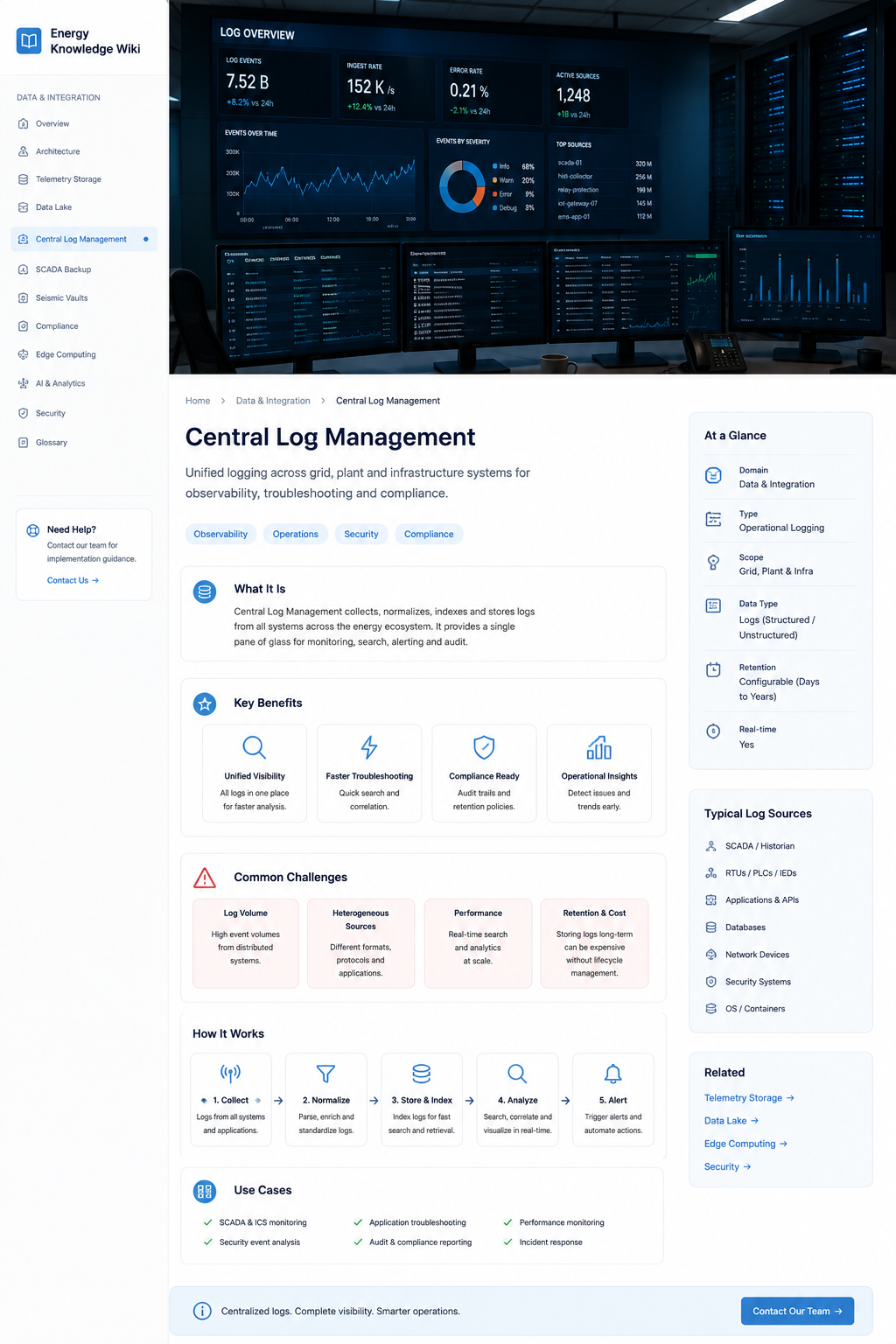
Central log management provides unified logging across grid, plant and infrastructure systems for observability. It collects, normalizes, indexes and stores logs so operators can troubleshoot incidents, monitor performance, support compliance and detect abnormal behavior.
What It Is
Central log management brings together logs from operational technology, IT systems, applications, network devices and security tools. It creates a searchable record of system behavior across energy operations.
In energy environments, logs help teams understand what happened, when it happened and which system or user was involved. This is essential for incident response, root-cause analysis, compliance reporting and operational resilience.
Key Pain Points
Energy infrastructure produces logs from many systems, vendors and protocols. Without centralization, teams spend too much time searching across disconnected sources.
Typical Log Sources
Central log management should cover both operational technology and supporting IT infrastructure.
| Source | Examples | Why It Matters |
|---|---|---|
| Control systems | SCADA, historian systems, RTUs, PLCs, IEDs | Supports operational traceability and incident reconstruction |
| Infrastructure | Servers, databases, storage systems, virtualization platforms | Shows health and performance of critical platforms |
| Network devices | Firewalls, routers, switches, gateways, VPN systems | Provides connectivity, access and segmentation visibility |
| Applications and security | APIs, business systems, SIEM alerts, identity systems | Supports security investigations, audit trails and compliance evidence |
Logging Workflow
Effective log management turns raw event records into searchable, correlated and actionable operational intelligence.
Architecture
Central log management architecture must handle large volumes while preserving searchability, retention and security.
Observability & Operations
Central logs are a foundation for observability. They become more powerful when combined with metrics, telemetry, traces, alarms and asset context.
| Operational Need | Log Management Contribution |
|---|---|
| Incident response | Correlates events across systems to understand sequence and impact. |
| Performance troubleshooting | Reveals errors, timeouts, failures and capacity issues across infrastructure. |
| Security monitoring | Tracks access attempts, configuration changes and suspicious behavior. |
| Compliance and audit | Preserves evidence of actions, events, changes and system behavior. |
Key Performance Metrics
Central log management should be measured by visibility, reliability and investigation speed.
Limitations & Practical Considerations
Central log management can become expensive if every event is retained at full detail indefinitely. Teams should define retention tiers, sampling rules and critical log categories.
Logs also require context. Without asset metadata, severity mapping and ownership, centralizing logs may improve storage but not investigation quality.
Related Deep Dives
Central log management connects telemetry storage, anomaly detection, energy security and data governance.