Data Governance
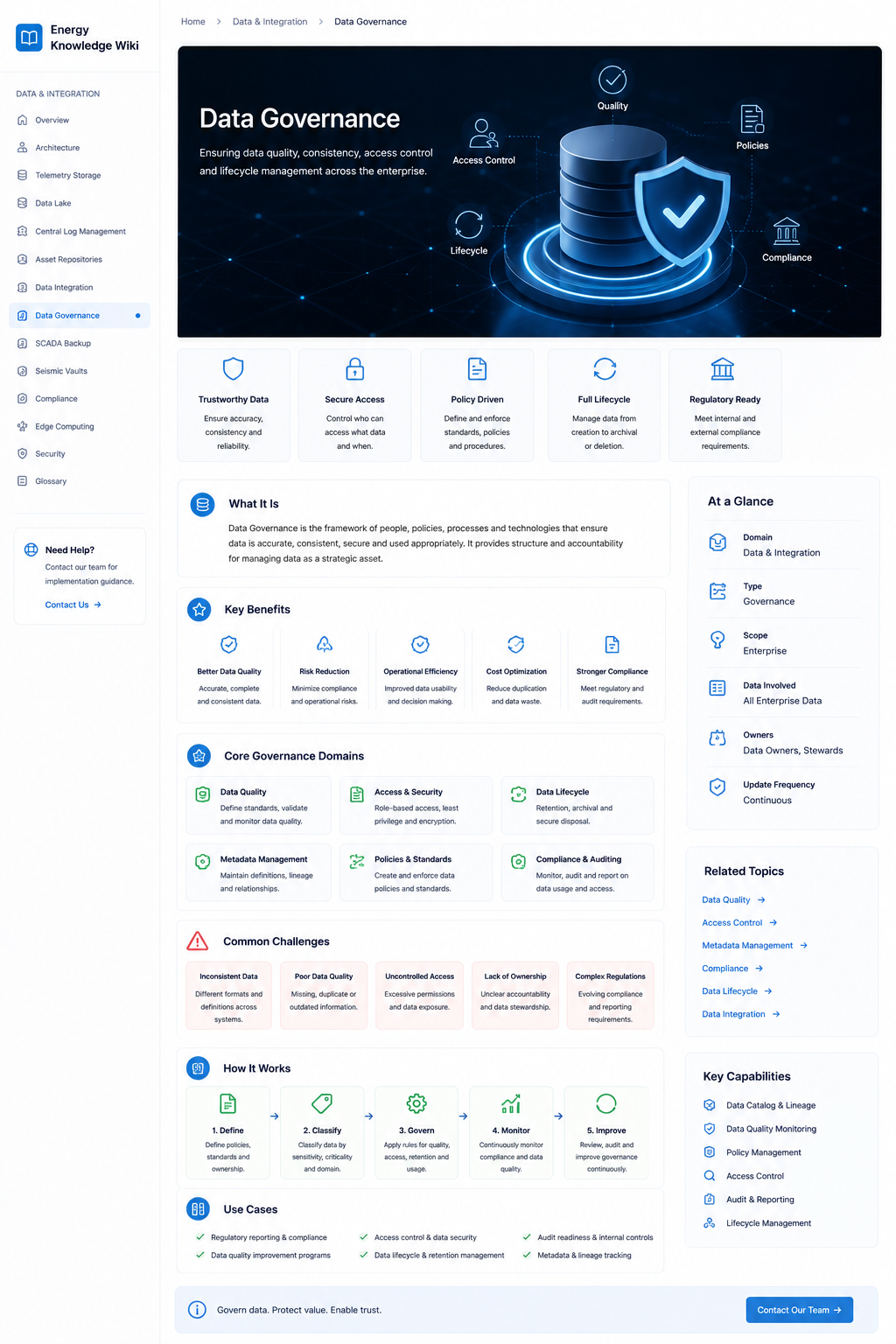
Data governance ensures data quality, consistency, access control and lifecycle management across energy operations. It defines ownership, standards, policies and controls so data can be trusted, protected and reused across analytics, AI, compliance and operational workflows.
What It Is
Data governance is the operating model for managing energy data as a trusted asset. It defines who owns data, how it is described, how quality is measured, who can access it and how it is retained or archived over time.
In energy systems, governance matters because data can affect safety, reliability, regulatory reporting, cyber risk, market decisions and infrastructure planning.
Key Pain Points
Without governance, energy data can become inconsistent, difficult to trust and risky to share across teams or systems.
Core Governance Domains
Data governance covers multiple domains that work together to make data trusted and usable.
| Domain | Purpose | Example Controls |
|---|---|---|
| Data quality | Ensures data is accurate, complete, valid and fresh | Validation rules, quality scores, exception workflows |
| Metadata management | Explains what data means, who owns it and how it should be used | Catalogs, definitions, lineage, ownership records |
| Access control | Protects sensitive data and limits access to authorized users | Role-based access, approvals, audit logs, least privilege |
| Lifecycle management | Controls retention, archiving, deletion and legal hold policies | Retention schedules, archival tiers, deletion approvals |
Governance Workflow
Governance should be embedded into the data lifecycle, not applied only after problems occur.
Governance Controls
Governance controls turn policies into enforceable practices across data platforms and workflows.
Lifecycle Management
Energy data has different lifecycle needs depending on business value, regulatory requirements, storage cost and operational risk.
| Lifecycle Stage | Governance Question |
|---|---|
| Create or ingest | Who owns the data and what quality checks are required? |
| Use and share | Who can access the data and for which purpose? |
| Retain | How long must the data remain available for operations, analytics or compliance? |
| Archive or delete | When should data move to archive or be safely removed? |
Key Performance Metrics
Data governance should be measured by trust, control, compliance and usability.
Limitations & Practical Considerations
Governance can fail if it becomes purely administrative. It must be connected to real data products, operational systems and team workflows.
The strongest governance programs focus first on high-value and high-risk datasets, then expand through repeatable standards, automation and stewardship practices.
Related Deep Dives
Data governance connects data integration, data lakes, compliance AI and asset repositories.