Telemetry Storage
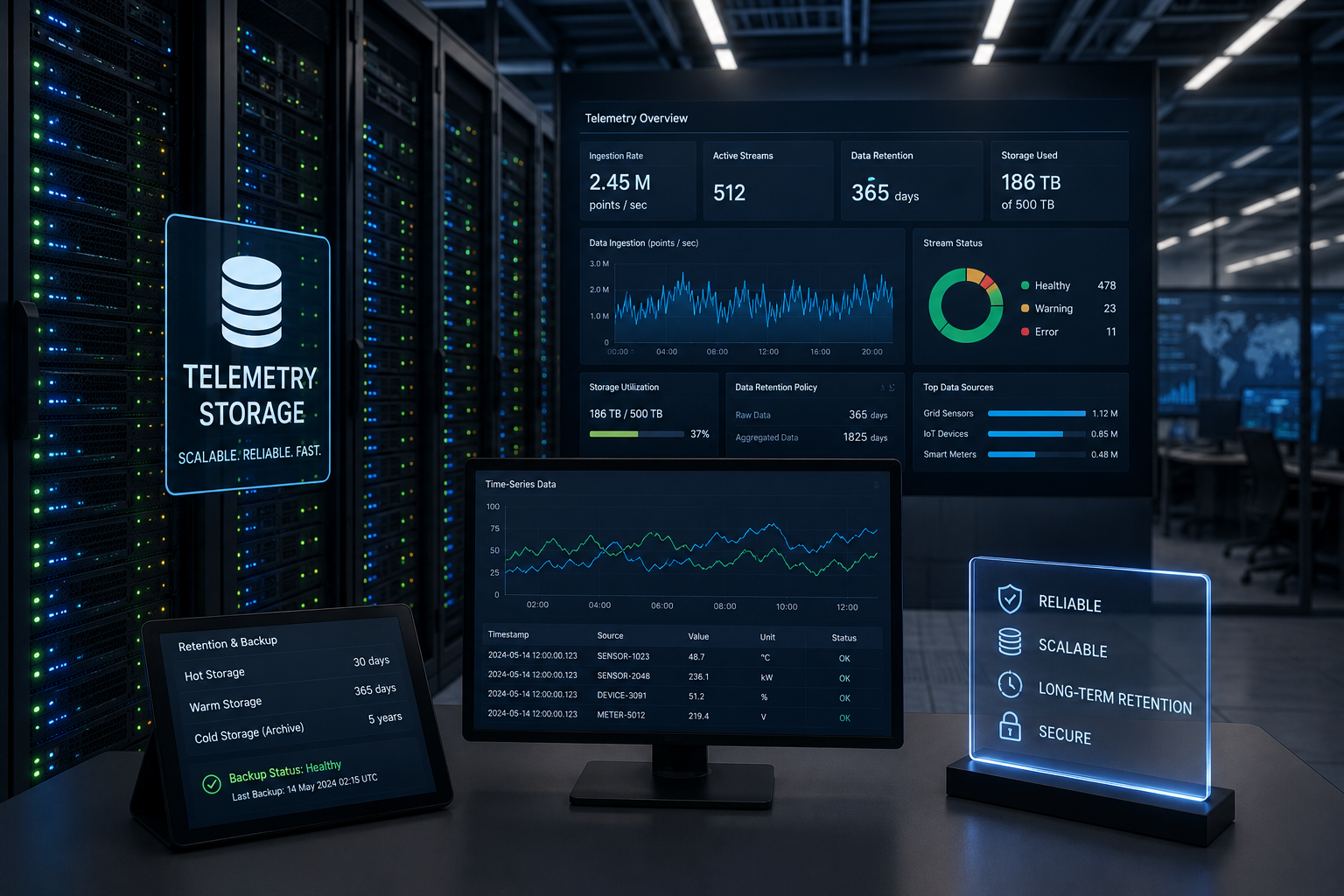
Telemetry storage provides time-series storage for sensor, IoT and grid telemetry data streams. It enables real-time monitoring, historical analysis, operational dashboards, anomaly detection and AI workflows across distributed energy infrastructure.
What It Is
Telemetry storage is designed for continuous streams of timestamped measurements from grid assets, meters, sensors, IoT devices and operational systems. Unlike document or file storage, telemetry platforms must handle high ingestion rates, precise timestamps, fast queries and long retention windows.
In energy operations, telemetry storage forms the data foundation for dashboards, predictive maintenance, load analytics, real-time control support and incident investigation.
Key Pain Points
Telemetry data is difficult to manage because it is continuous, distributed, noisy and time-sensitive. Energy operators need both real-time access and long-term historical context.
Telemetry Data Model
Telemetry storage depends on a consistent time-series model. Each reading should include enough context to support monitoring, analytics and troubleshooting.
| Field | Description | Example |
|---|---|---|
| Timestamp | Precise time of measurement or event | 2026-05-06T14:30:05Z |
| Source | Sensor, device, meter, inverter, substation or asset identifier | Transformer-17 / Meter-2048 |
| Metric | Measured signal or operational variable | Voltage, current, temperature, load, pressure |
| Value and quality | Measurement value plus validation or quality flag | 235.4 V / Valid |
Data Flow
A reliable telemetry storage workflow moves data from field devices into searchable, governed and analytics-ready storage.
Storage Architecture
Telemetry storage architecture must balance ingestion speed, query performance, data retention and cost.
Retention & Governance
Telemetry retention should be designed around operational needs. High-frequency raw data may be kept for short periods, while aggregated data can be retained longer for planning and compliance.
| Retention Layer | Purpose |
|---|---|
| Raw high-frequency data | Short-term troubleshooting, incident replay and detailed diagnostics. |
| Aggregated data | Longer-term analytics, reporting, trend analysis and forecasting. |
| Event snapshots | Critical incident evidence, alarms, exceptions and operational context. |
| Governed archive | Compliance, audit, historical analysis and long-term system planning. |
Key Performance Metrics
Telemetry storage should be measured by data availability, ingestion reliability, query speed and cost efficiency.
Limitations & Practical Considerations
Telemetry storage is only valuable if timestamps, metadata and quality flags are reliable. Poor data modeling can make large telemetry stores difficult to query or interpret.
Teams should define retention policies, naming conventions, device metadata and quality rules early, before data volume makes cleanup expensive.
Related Deep Dives
Telemetry storage connects real-time analytics, anomaly detection, load analytics and data governance.