Wind Farm Optimization
Wind farm optimization focuses on maximizing total energy production while controlling structural loads, downtime and maintenance costs. Because turbines interact aerodynamically and mechanically, the best operating strategy is often a farm-level decision rather than a turbine-by-turbine maximum output strategy.
Wind Farm Pain Points
Wind farms are complex aerodynamic systems. A control action on one turbine can affect multiple downstream turbines, structural loads and maintenance outcomes. This makes optimization a multi-objective problem rather than a simple power-maximization task.
The main challenge is to balance energy production, component lifetime and operational reliability under changing atmospheric conditions.
Wake Effects & Farm-Level Losses
A wind turbine extracts kinetic energy from the wind. Behind the rotor, the flow contains lower wind speed and higher turbulence. This disturbed flow is called a wake. In large wind farms, wakes can overlap and create significant downstream losses.
Traditional control often attempts to maximize the output of each individual turbine. However, this may not maximize total farm production because upstream turbines can reduce the available energy for downstream machines.
| Effect | Operational Impact | Optimization Relevance |
|---|---|---|
| Wind speed deficit | Downstream turbines receive less usable wind energy | Reduces farm-level power output |
| Increased turbulence | Higher mechanical loading and fatigue | Affects reliability and maintenance planning |
| Wake overlap | Multiple turbine rows interact | Requires coordinated farm-level control |
Wake Steering
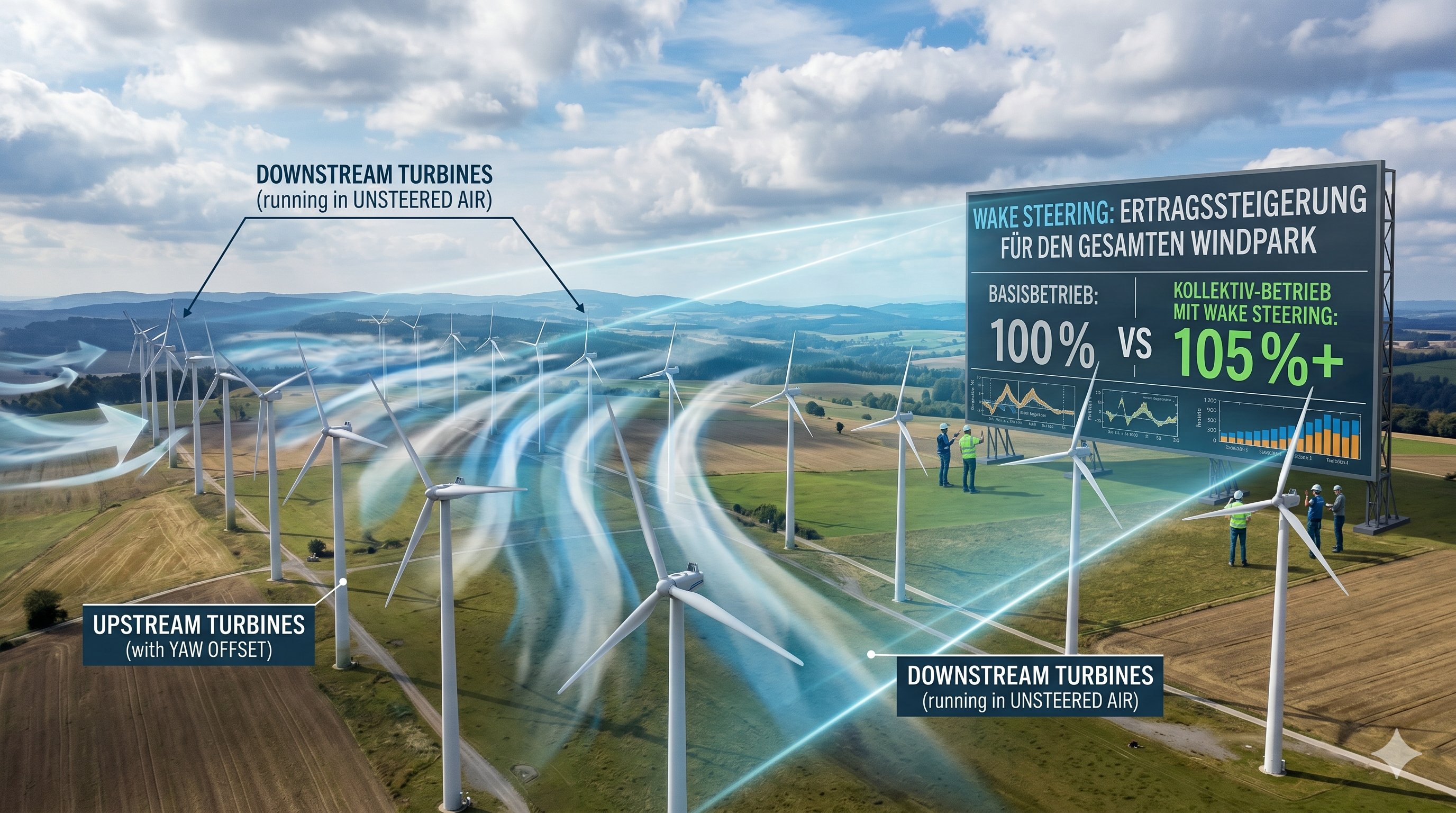
Wake steering intentionally adjusts the yaw angle of selected upstream turbines so their wakes are redirected away from downstream turbines. The upstream turbine may produce slightly less power, but the overall wind farm can gain if downstream turbines recover more energy than the upstream turbine loses.
The value of wake steering depends strongly on wind direction, spacing, atmospheric stability, turbulence intensity and the accuracy of the wake model. It is best understood as a conditional optimization technique, not a universal performance guarantee.
| Aspect | Individual Turbine Control | Wake Steering Optimization |
|---|---|---|
| Objective | Maximize each turbine locally | Maximize farm-level performance |
| Yaw strategy | Align directly with incoming wind | Introduce controlled yaw offsets |
| Trade-off | Local output focus | Upstream loss vs. downstream recovery |
Gearbox Health & Predictive Maintenance
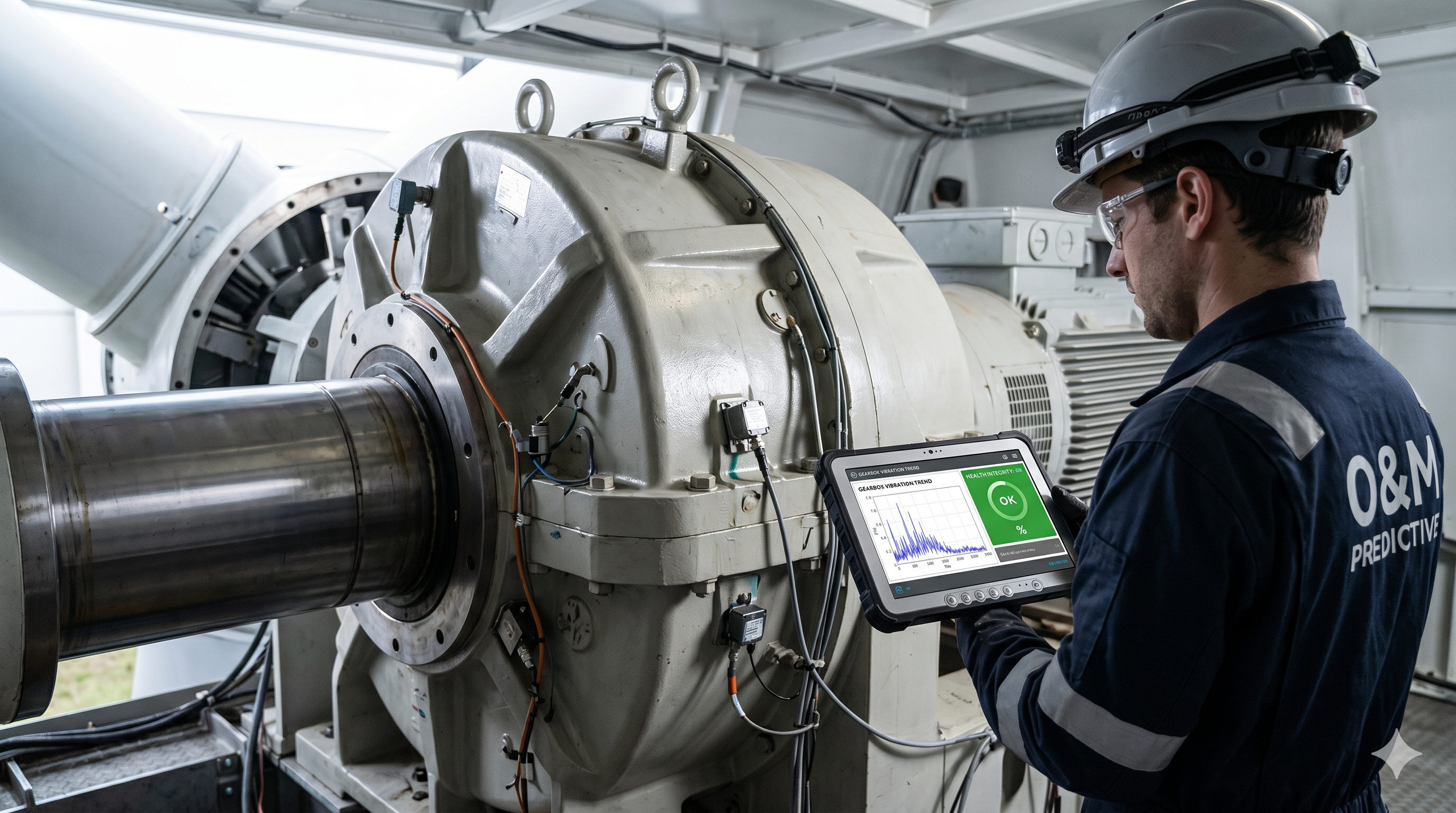
Gearboxes operate under variable torque, vibration and temperature conditions. Wake turbulence, misalignment and repeated load cycles can increase drivetrain stress. For this reason, wind farm optimization should include reliability metrics, not only energy production metrics.
Gearbox health monitoring uses vibration data, oil analysis, temperature signals, SCADA trends and anomaly detection to identify early signs of mechanical degradation. Predictive maintenance helps reduce unplanned downtime and avoid major component failures.
Control & Optimization Architecture
A wind farm optimization layer typically connects meteorological data, turbine telemetry, SCADA systems, condition monitoring and control models. It can operate as an advisory system or as part of a supervised control workflow depending on safety, certification and operator requirements.
| Layer | Function | Examples |
|---|---|---|
| Field layer | Captures wind, turbine and drivetrain conditions | Anemometers, LiDAR, vibration sensors, temperature sensors |
| Data layer | Normalizes operational and environmental signals | SCADA, historian data, maintenance logs, weather feeds |
| Model layer | Estimates wake behavior, loads and failure risk | Wake models, digital twins, anomaly detection, fatigue models |
| Decision layer | Recommends control and maintenance actions | Yaw offsets, derating, inspections, maintenance prioritization |
Key Performance Metrics
Wind farm optimization is measured through both production and reliability outcomes. A strategy that increases short-term output but accelerates fatigue may not be optimal over the asset lifetime.
Limitations & Practical Considerations
Wind farm optimization is site-specific. The impact of wake steering and load-aware control depends on layout, turbine type, terrain, atmospheric conditions, sensor quality and operational constraints.
Performance gains should be stated carefully. In practice, improvements may be modest on an annual basis even if specific wind directions or operating windows show larger gains. A credible optimization workflow should include validation against baseline performance and long-term reliability effects.