Accelerated Simulation
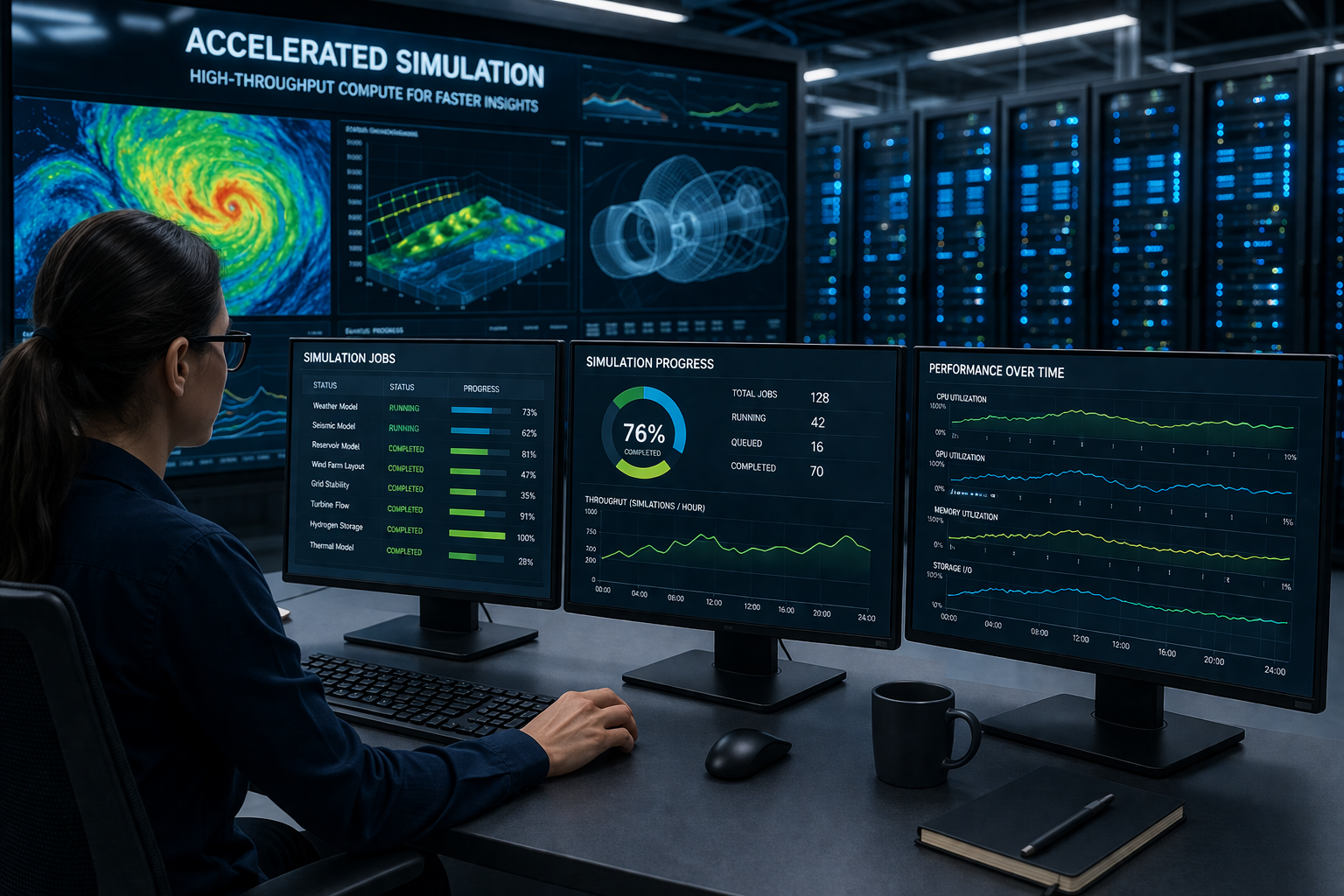
Accelerated simulation uses high-throughput compute, optimized solvers, parallel scenario execution and model approximations to shorten simulation cycles for planning and response. It helps energy teams evaluate more scenarios faster without waiting for long sequential runs.
What It Is
Accelerated simulation reduces the time needed to run complex energy simulations. Instead of treating each simulation as a long isolated job, accelerated workflows use parallel execution, hardware acceleration, reduced-order models, precomputed scenarios and automated pipelines.
The goal is not always real-time control. In many cases the value comes from running more planning scenarios overnight, reducing iteration time for engineers or quickly narrowing the range of likely outcomes during an operational event.
Key Pain Points
Energy simulations can be too slow for iterative planning, uncertainty analysis or fast response. Acceleration focuses on reducing bottlenecks without losing decision relevance.
Acceleration Approaches
Accelerated simulation is not one technique. It is a toolbox of compute, workflow and modeling methods.
| Approach | How It Helps | Trade-Off |
|---|---|---|
| Parallel scenario execution | Runs many independent simulations at the same time | Requires enough compute capacity and orchestration |
| GPU acceleration | Speeds up selected numerical solvers and data processing steps | Requires compatible algorithms and software stacks |
| Reduced-order models | Approximates complex physics with faster mathematical representations | May be less accurate outside trained or calibrated regimes |
| Surrogate models | Uses ML or statistical models to estimate outputs from prior simulations | Needs validation and uncertainty bounds |
| Workflow automation | Removes manual delays in setup, execution, monitoring and post-processing | Requires reliable pipelines and governance |
Accelerated Simulation Workflow
A practical accelerated workflow identifies where time is lost, applies the right acceleration method and validates whether the faster result is still useful for the decision.
Energy Applications
Accelerated simulation is useful when decisions depend on many possible futures or repeated model updates.
Role of HPC
HPC provides the compute foundation for accelerated simulation, especially when many scenarios can be parallelized. Orchestration, storage and monitoring are just as important as raw compute power.
| HPC Capability | Accelerated Simulation Role |
|---|---|
| High-throughput execution | Runs large batches of independent simulations across many nodes. |
| GPU and accelerator nodes | Shortens solver or inference workloads where algorithms support acceleration. |
| Workflow orchestration | Automates job submission, monitoring, retries and result collection. |
| Fast storage and data pipelines | Reduces bottlenecks caused by simulation input/output and post-processing. |
Key Performance Metrics
Accelerated simulation should be measured by time savings and decision quality, not speed alone.
Limitations & Practical Considerations
Faster simulation is not automatically better. Approximation methods must be validated, and accelerated results should include uncertainty or confidence information when they support important decisions.
The best use cases are those where the decision benefits more from exploring many plausible scenarios than from over-refining one slow model run.
Related Deep Dives
Accelerated simulation connects HPC infrastructure with domain-specific simulation workloads.