Reservoir Modeling
Reservoir modeling simulates how fluids move through porous rock over time. It supports extraction strategy evaluation, production forecasting and uncertainty analysis by connecting geology, well data, rock physics and numerical flow simulation.
What It Is
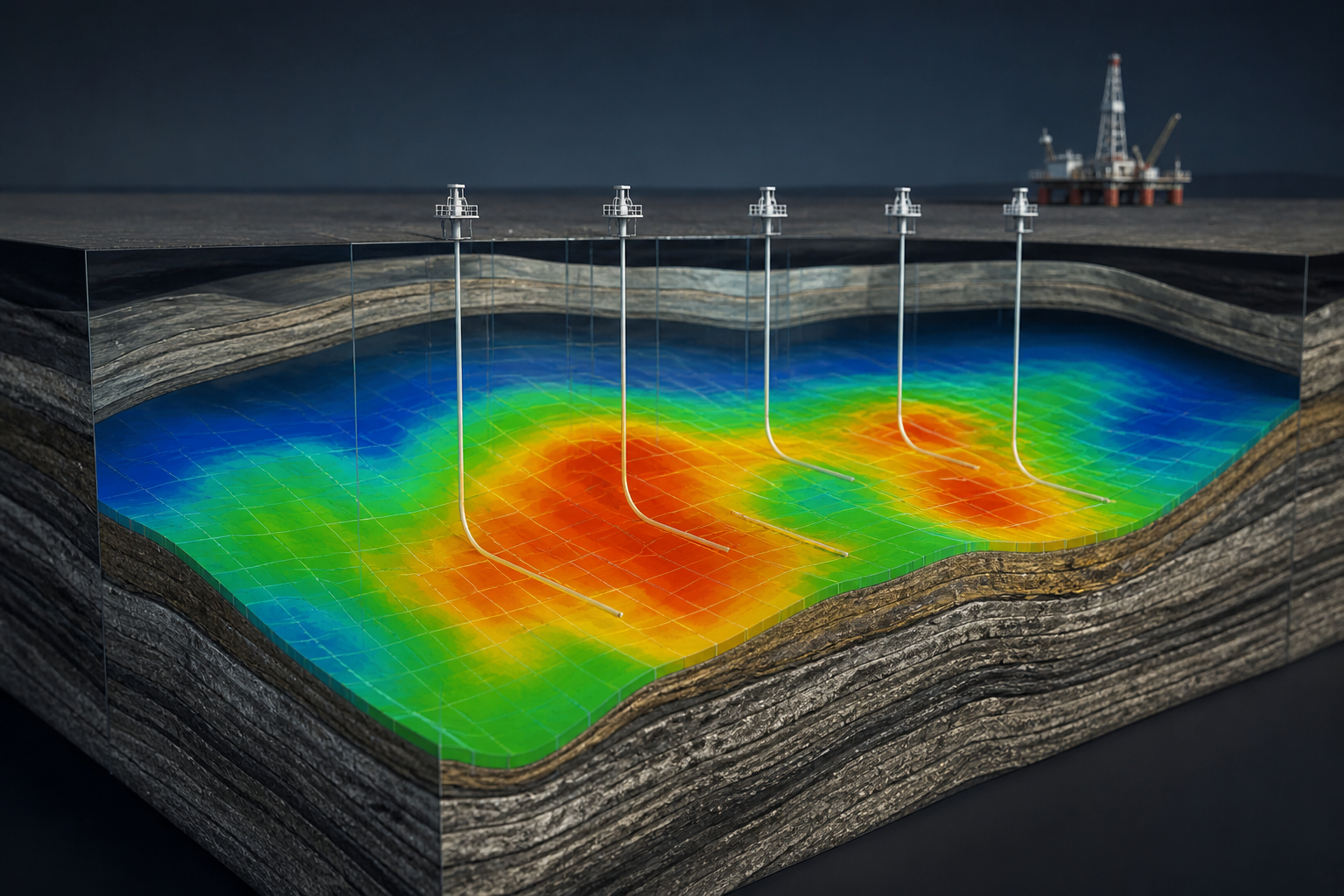
Reservoir modeling creates a digital representation of underground reservoirs to estimate pressure, saturation, permeability, fluid movement and production behavior. These models help teams compare development options before committing to costly drilling or recovery decisions.
A reservoir model is not a direct image of reality. It is a calibrated decision model built from seismic interpretation, well logs, core samples, production history and engineering assumptions.
Key Pain Points
Reservoir decisions are expensive and uncertain. Even small errors in permeability, pressure or connectivity assumptions can significantly change production forecasts and recovery strategies.
Reservoir Model Components
A useful reservoir model combines geological structure, rock properties, fluids, wells and operational constraints into a simulation-ready framework.
| Component | Purpose | Typical Inputs |
|---|---|---|
| Structural model | Defines layers, faults and reservoir geometry | Seismic interpretation, well markers, geological mapping |
| Property model | Assigns porosity, permeability and saturation | Well logs, core data, seismic attributes |
| Fluid model | Represents oil, gas, water and phase behavior | PVT data, lab measurements, production samples |
| Well model | Simulates production and injection behavior | Well trajectories, completions, operational constraints |
Simulation Workflow
Reservoir modeling is usually iterative. The model is built, simulated, compared against observed history and then updated until it provides a useful representation for decision-making.
Extraction Strategy Evaluation
Reservoir models allow teams to compare different development and recovery strategies before implementation. This helps reduce financial risk and improve recovery planning.
Uncertainty & Scenario Ensembles
Because reservoir models are built from incomplete data, uncertainty analysis is central. Teams often run ensembles of possible models to estimate a range of outcomes rather than relying on one deterministic forecast.
| Uncertainty Source | Why It Matters |
|---|---|
| Permeability distribution | Controls fluid flow paths and production performance. |
| Fault connectivity | Affects compartmentalization and pressure communication. |
| Fluid properties | Influence phase behavior, mobility and recovery efficiency. |
| Operational constraints | Limit achievable production and injection strategies. |
Role of High Performance Computing
HPC is essential when reservoir models become large, detailed or probabilistic. Fine grids, multi-phase physics and ensemble simulations can quickly exceed desktop-scale compute.
| HPC Capability | Reservoir Modeling Role |
|---|---|
| Parallel simulation | Runs large reservoir models and scenario ensembles faster. |
| GPU acceleration | Can speed up selected numerical solvers and optimization workflows. |
| High-performance storage | Manages simulation outputs, restart files and model ensembles. |
| Workflow orchestration | Coordinates calibration, simulation, sensitivity analysis and reporting. |
Key Performance Metrics
Reservoir modeling should be evaluated by model quality, forecast usefulness, compute efficiency and decision impact.
Limitations & Practical Considerations
Reservoir models are simplifications. They depend on assumptions about geology, rock properties, fluid behavior and operations. Even a well-calibrated model may fail when conditions change or when unknown heterogeneity dominates flow behavior.
The strongest workflows combine simulation with uncertainty quantification, field surveillance, updated production data and expert interpretation.
Related Deep Dives
Reservoir modeling sits between seismic interpretation, HPC simulation and production decision-making.