Price Forecasting
Price forecasting models energy market price dynamics and volatility using AI, statistics and market fundamentals. It supports trading, procurement, dispatch planning, storage optimization and risk management across electricity and energy markets.
What It Is
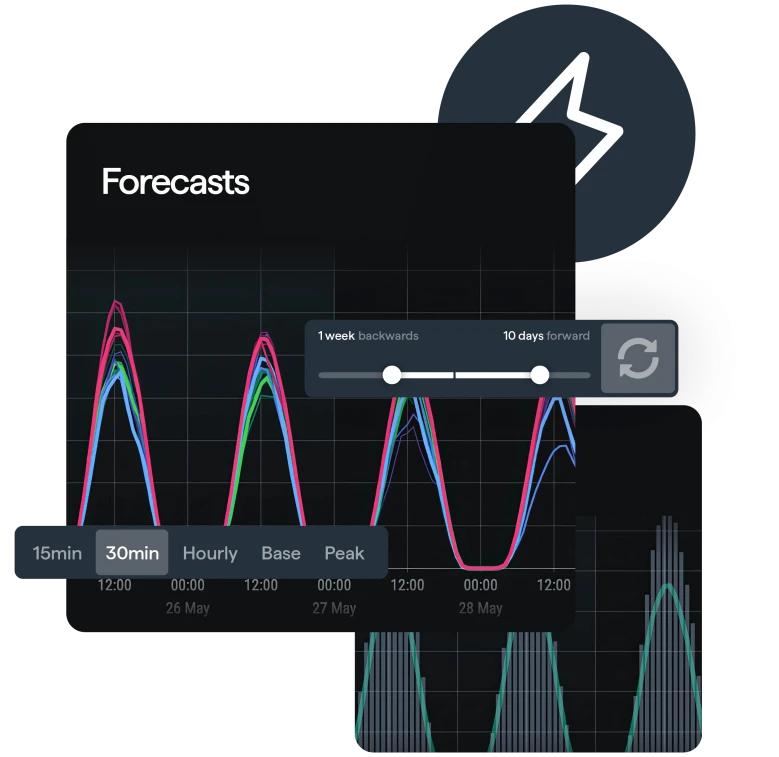
Energy price forecasting estimates future prices based on supply, demand, fuel costs, renewable generation, weather, grid constraints, storage behavior, market rules and historical price patterns.
In energy markets, prices can change quickly because supply and demand must stay balanced in real time. Forecasting therefore needs to capture both structural drivers and short-term volatility.
Key Pain Points
Energy prices are highly sensitive to weather, demand, fuel prices, outages, congestion and renewable variability. This makes forecasting useful, but difficult.
Price Drivers
Energy price forecasting combines many signals. The strongest models separate structural market fundamentals from short-term operational events.
| Driver | How It Affects Prices | Typical Data |
|---|---|---|
| Demand | Higher load can increase scarcity and raise marginal generation costs | Load forecasts, smart meter data, weather-adjusted demand |
| Renewable output | High wind or solar can reduce prices; sudden drops can increase volatility | Weather forecasts, generation forecasts, curtailment signals |
| Fuel and carbon costs | Gas, coal and carbon prices influence generation cost and market clearing prices | Fuel prices, carbon prices, generation mix data |
| Grid congestion | Transmission constraints create local price differences and scarcity zones | Grid constraints, line loading, nodal or zonal market data |
Forecasting Workflow
A practical forecasting workflow combines data engineering, feature creation, model training, uncertainty estimation and operational monitoring.
Methods
Price forecasting often uses a hybrid approach because energy prices reflect both physical fundamentals and market behavior.
Volatility & Risk Management
Energy price forecasting is not only about point predictions. Volatility, spike risk and confidence bands often matter more than a single expected price.
| Risk Area | Forecasting Contribution |
|---|---|
| Procurement risk | Helps buyers decide when and how much energy to contract or hedge. |
| Storage dispatch | Supports charge/discharge decisions based on expected price spreads. |
| Trading strategy | Identifies price opportunities and downside risk under volatile conditions. |
| Renewable revenue | Estimates capture prices and exposure to periods of low or negative prices. |
Key Performance Metrics
Price forecasting should be evaluated by accuracy, risk awareness and operational usefulness.
Limitations & Practical Considerations
Energy price forecasts are uncertain because markets can change rapidly due to outages, policy shifts, fuel shocks, extreme weather or changes in bidding behavior. Forecasts should include uncertainty ranges and scenario views.
Models also need regular monitoring. A model that performs well in one market regime may degrade when renewable penetration, market rules or fuel-price dynamics change.
Related Deep Dives
Price forecasting connects AI intelligence with market trends, demand intelligence, storage optimization and real-time analytics.