Seismic Simulation
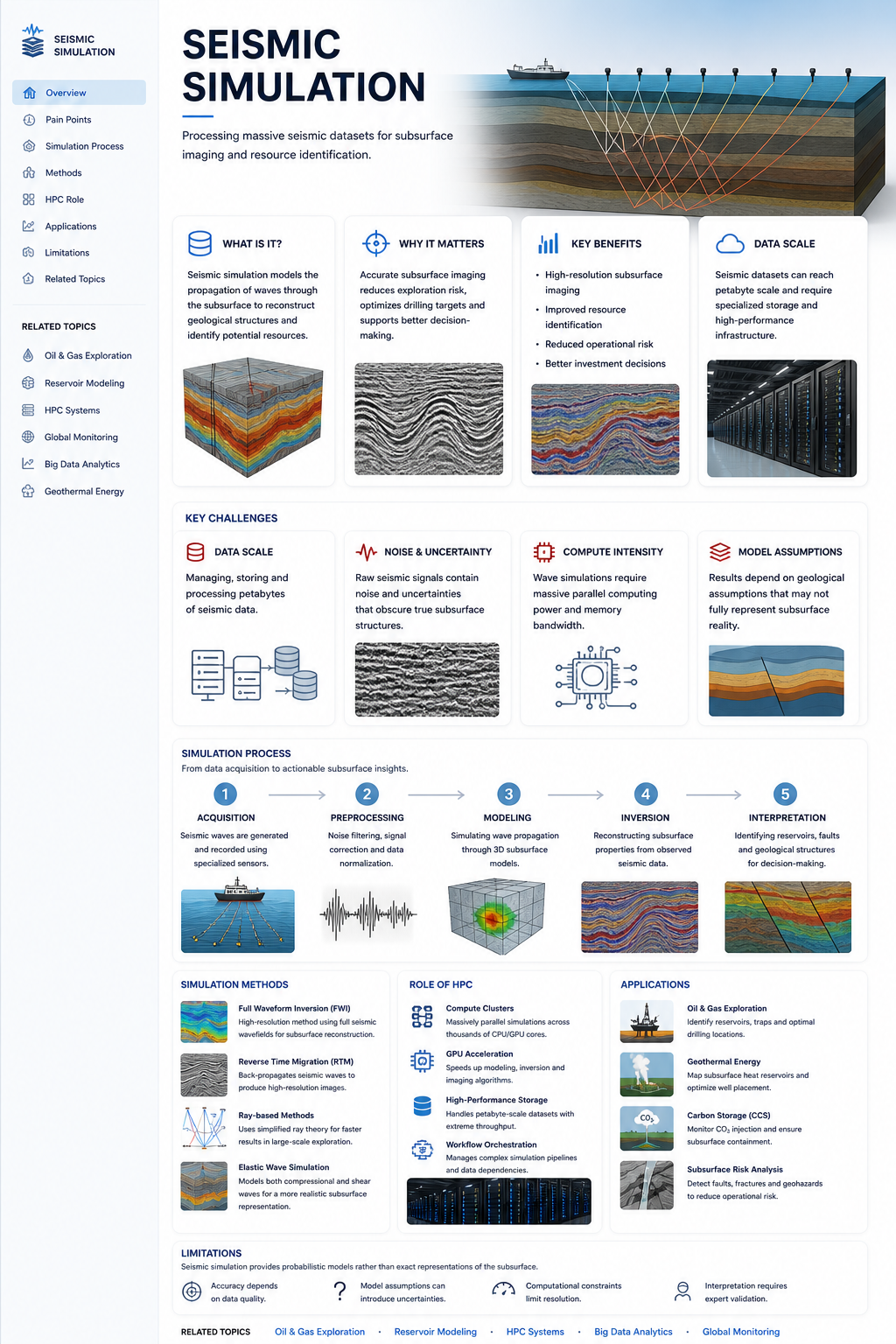
Seismic simulation processes massive seismic datasets to model wave propagation through the subsurface. It supports subsurface imaging, resource identification and risk assessment in oil and gas, geothermal energy, carbon storage and broader subsurface engineering.
What It Is
Seismic simulation uses physical and numerical models to understand how seismic waves travel through rock layers, faults, salt bodies and reservoirs. By comparing simulated wavefields with measured seismic data, geoscientists can infer subsurface structures that cannot be directly observed.
It is closely related to seismic imaging, seismic inversion and Full Waveform Inversion. The objective is not to create a perfect picture of the subsurface, but to reduce uncertainty and support better exploration and development decisions.
Key Pain Points
Seismic workflows are among the most data- and compute-intensive processes in the energy sector. The difficulty comes from the combination of large data volumes, complex physics and non-unique geological interpretation.
Simulation Process
Seismic simulation transforms raw measurement data into interpretable subsurface insight. The workflow usually combines field acquisition, signal processing, numerical modelling and expert interpretation.
Simulation Methods
Different methods balance physical accuracy, compute cost and interpretability. High-resolution methods can reveal more detail, but they are more expensive and sensitive to data quality.
Role of High Performance Computing
Seismic simulation is one of the classic HPC workloads in energy. Large 3D domains, fine grid resolution, many source-receiver combinations and iterative inversion loops create enormous compute and storage demand.
| HPC Component | Role in Seismic Simulation |
|---|---|
| Compute clusters | Run massively parallel wave simulations across large subsurface domains. |
| GPU acceleration | Speeds up modelling, imaging and inversion workloads. |
| High-performance storage | Handles repeated reads and writes of very large seismic volumes. |
| Workflow orchestration | Coordinates preprocessing, simulation, inversion and interpretation pipelines. |
Applications
Seismic simulation is most established in oil and gas exploration, but the same computational principles are increasingly relevant for geothermal projects, carbon storage and subsurface risk analysis.
Key Performance Metrics
Seismic simulation should be evaluated by both computational performance and geological usefulness.
Limitations & Practical Considerations
Seismic simulation does not produce an exact representation of the subsurface. Multiple geological models can explain similar seismic observations, especially when data coverage is sparse or noisy.
Results must be validated with well logs, rock physics, geological interpretation and uncertainty analysis. HPC can increase resolution and throughput, but it cannot remove uncertainty by itself.
Related Deep Dives
Seismic simulation is a deep-dive page connected to the HPC and exploration parts of the Energy Wiki.