Asset Repositories
Asset repositories are digital asset libraries storing infrastructure models, history and metadata. They provide a trusted source for equipment records, design documents, inspection history, configuration files and operational context across energy systems.
What It Is
Asset repositories centralize the digital information needed to understand and operate physical energy infrastructure. They can store 3D models, engineering drawings, inspection reports, maintenance history, configuration files, geospatial data and operational metadata.
Their value comes from connecting documents, models and records to real assets. This makes asset information easier to find, reuse, audit and integrate into analytics or maintenance workflows.
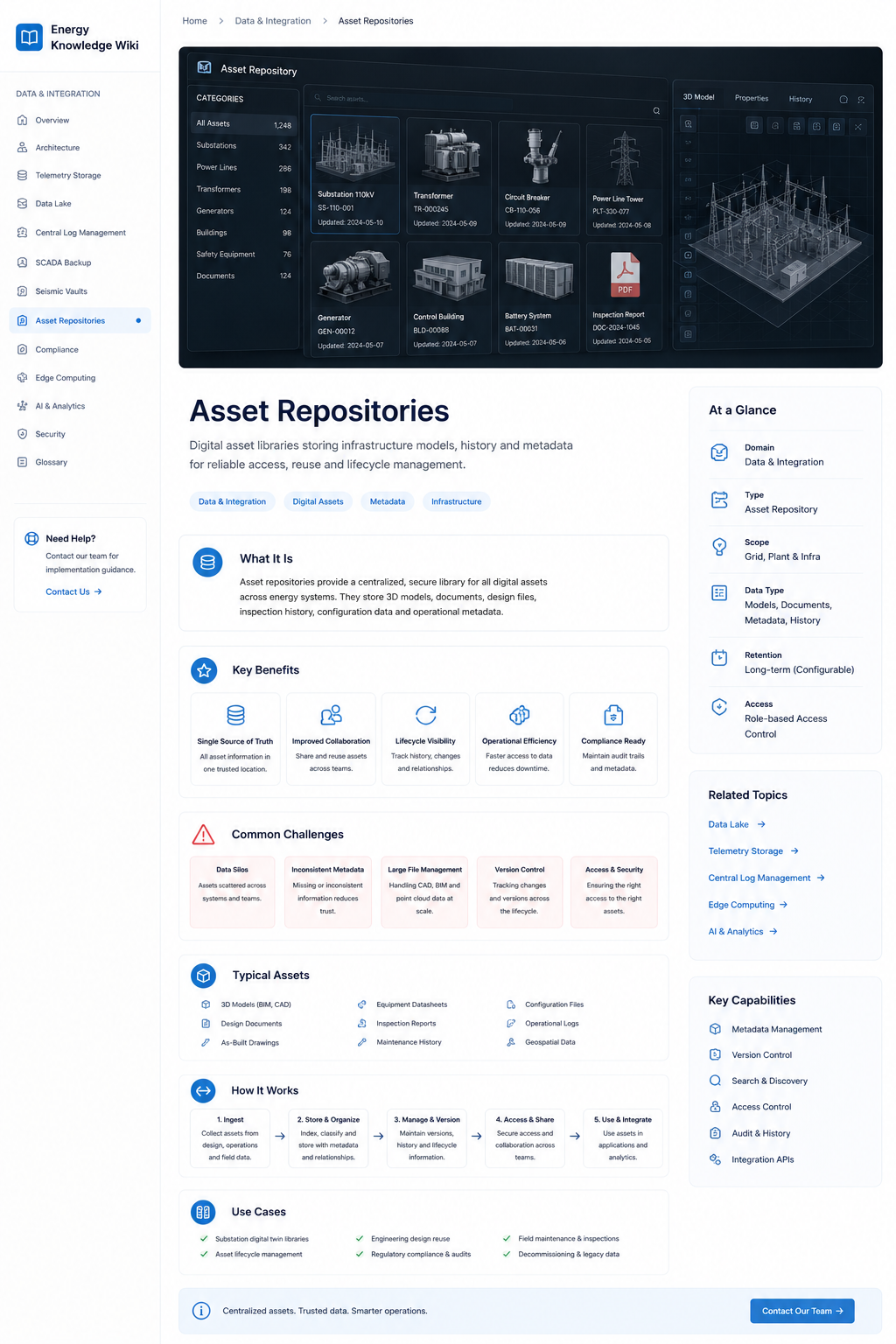
Key Pain Points
Asset data is often scattered across engineering systems, maintenance platforms, document folders and field records. This makes operational decisions slower and less reliable.
Typical Asset Records
Asset repositories should support different file types, metadata structures and lifecycle records across the energy asset base.
| Asset Record | Examples | Operational Use |
|---|---|---|
| Models and drawings | 3D models, BIM files, CAD drawings, as-built documentation | Engineering design, field planning, digital twins |
| Maintenance history | Work orders, service logs, failure records, inspection reports | Predictive maintenance, lifecycle analysis, reliability planning |
| Configuration data | Device settings, control parameters, firmware records, network maps | Change management, recovery, compliance and troubleshooting |
| Metadata and location | Asset IDs, ownership, geospatial coordinates, hierarchy, criticality | Search, governance, risk ranking and analytics integration |
Repository Workflow
A useful asset repository is built around lifecycle management: ingest, organize, version, govern and integrate.
Repository Architecture
Asset repositories combine file storage, metadata, search, access control and integrations with operational systems.
Governance & Lifecycle Control
Asset repositories need strong governance because infrastructure information is used for operational, safety, maintenance and compliance decisions.
| Governance Area | Why It Matters |
|---|---|
| Role-based access | Ensures sensitive infrastructure information is available only to authorized users. |
| Version control | Prevents outdated drawings, models or configurations from being used in operations. |
| Metadata quality | Improves search, discovery and integration with analytics systems. |
| Audit history | Tracks who changed asset records, when they changed and why. |
Key Performance Metrics
Asset repositories should be measured by trust, reuse and operational usefulness.
Limitations & Practical Considerations
Asset repositories can become file dumps if metadata, ownership and version control are not enforced. The repository must be designed around asset relationships, not just folders.
Integration with field operations, maintenance systems, GIS and analytics platforms is important so the repository becomes part of daily workflows rather than a passive archive.
Related Deep Dives
Asset repositories connect data management with field operations, infrastructure monitoring, data governance and digital twins.